Count alcohol content rather than glasses in a recovery journal
By Mr.Apps · Oct 22, 2026
Category:Wearable
A drink journal becomes less useful when every glass is treated as the same unit. A small pour and a large pour may use similar glassware, while two beverages in equal-size containers may differ in alcohol concentration. If I want a record that can be reviewed later, I keep the serving amount and the stated strength visible instead of entering only “one glass.” That makes the entry more interpretable; it does not make the journal a test of impairment, health, or recovery.
The distinction matters when someone is trying to understand how evening intake relates to sleep, next-day energy, or a wearable estimate. Those measures can vary for many reasons, and a pattern in a personal log cannot establish that alcohol caused a particular change. A better record starts with clear exposure information, keeps uncertainty visible, and leaves clinical interpretation to an appropriate professional.
Why “one glass” is not a consistent measurement
A glass is a container, not a fixed amount of alcohol. People use different glass sizes, pour different amounts, and may refill without noticing that the second pour is larger. Beverage strength also varies. Alcohol by volume, usually written as a percentage, describes how much of the beverage volume is pure alcohol. A larger amount at a higher percentage contains more alcohol than a smaller amount at a lower percentage.
For comparison, one commonly used standard-drink unit is defined as about 14 grams, or 0.6 fluid ounces, of pure alcohol. The familiar examples are approximations: a measured serving of beer, wine, or distilled spirits can each contain about that amount, but customary pours do not always match those reference sizes. A clinical summary of drink size and strength also stresses that an ordinary container may hold multiple standard servings. A standard-drink guide explains why glass appearance alone is a poor substitute for amount and strength.
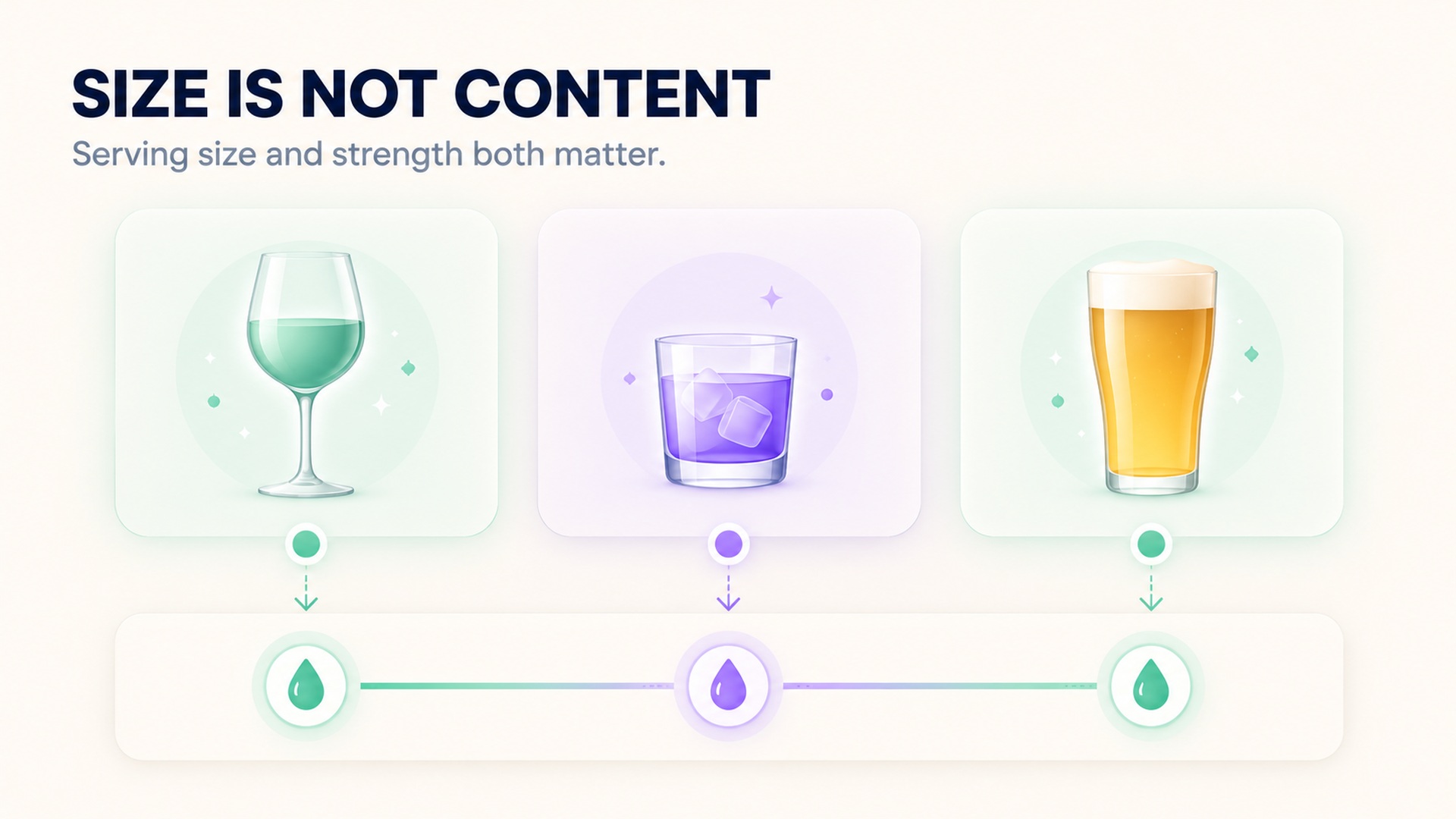
This standard-drink concept is a bookkeeping unit. It helps compare unlike beverages on a common scale; it is not a personal safety threshold or a promise that equal counts produce equal effects. Body size, food, timing, medications, health conditions, and individual response can all change what someone experiences. A journal should therefore preserve the actual serving details rather than imply that a rounded count predicts blood alcohol concentration or fitness to drive.
Record the inputs before interpreting a trend
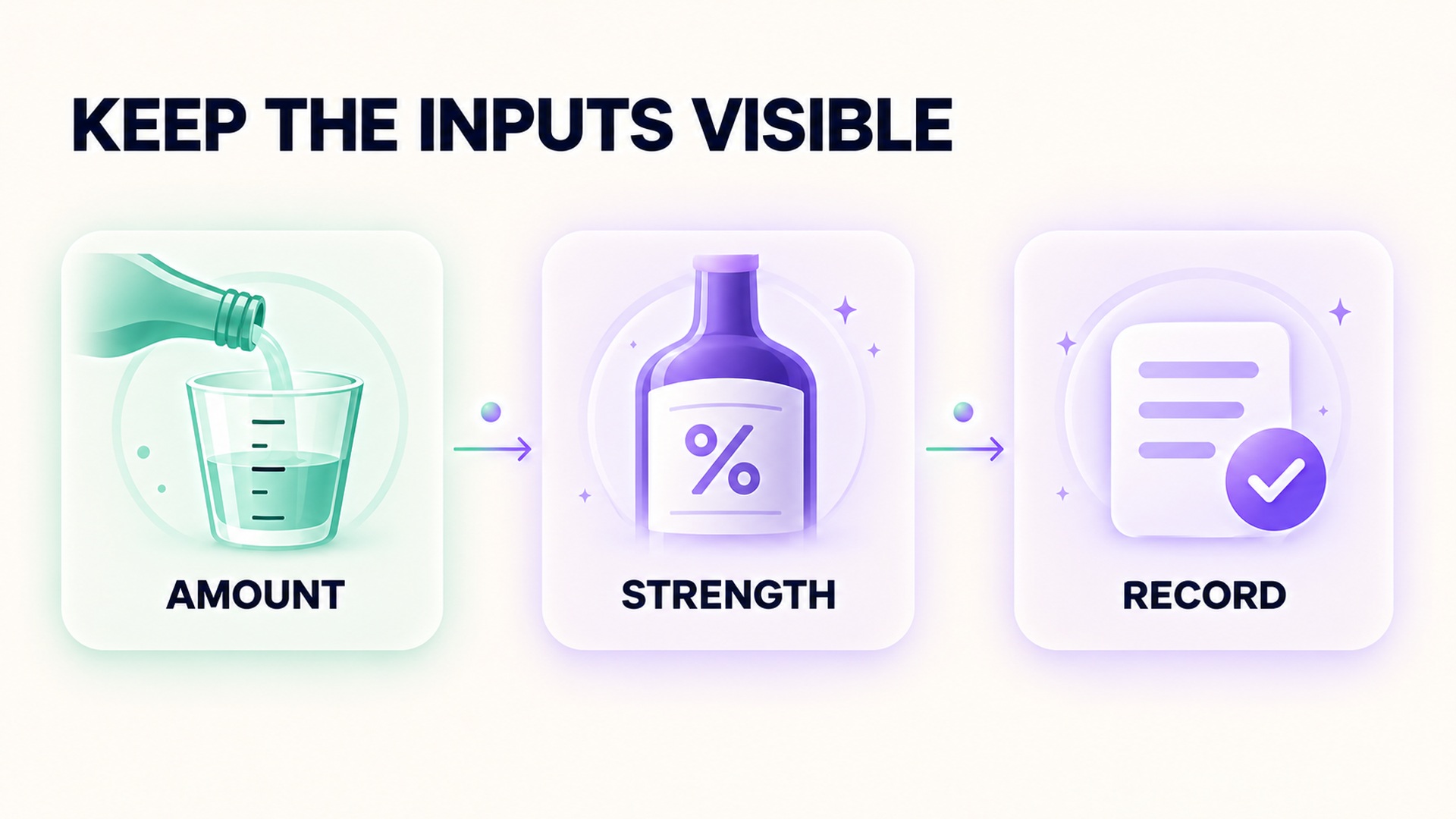
A useful entry can be brief. Note what type of beverage it was, the amount poured or consumed, the alcohol-by-volume percentage when available, and the time. If the label gives a serving size, capture that separately from the amount actually poured. If the amount is uncertain, say so. A transparent estimate is more useful than a precise-looking number built from an unknown glass size.
For a packaged beverage, the container volume and percentage may be printed on the label. For a mixed drink, the recipe and the quantities of its ingredients matter. One cocktail can contain more than one standard drink depending on the amount and strength of the spirits used. A drink-size calculator can illustrate how volume and concentration combine, but its result is only as good as the measurements entered. An uncertain pour should remain an uncertain entry.
When no label or recipe is available, avoid inventing a value. Record the observable details—such as “restaurant pour, size unknown”—and consider whether that entry should be excluded from a precise comparison. It is still worth preserving the event if the goal is a broad diary, but readers should not treat a rough estimate as equivalent to a measured serving.
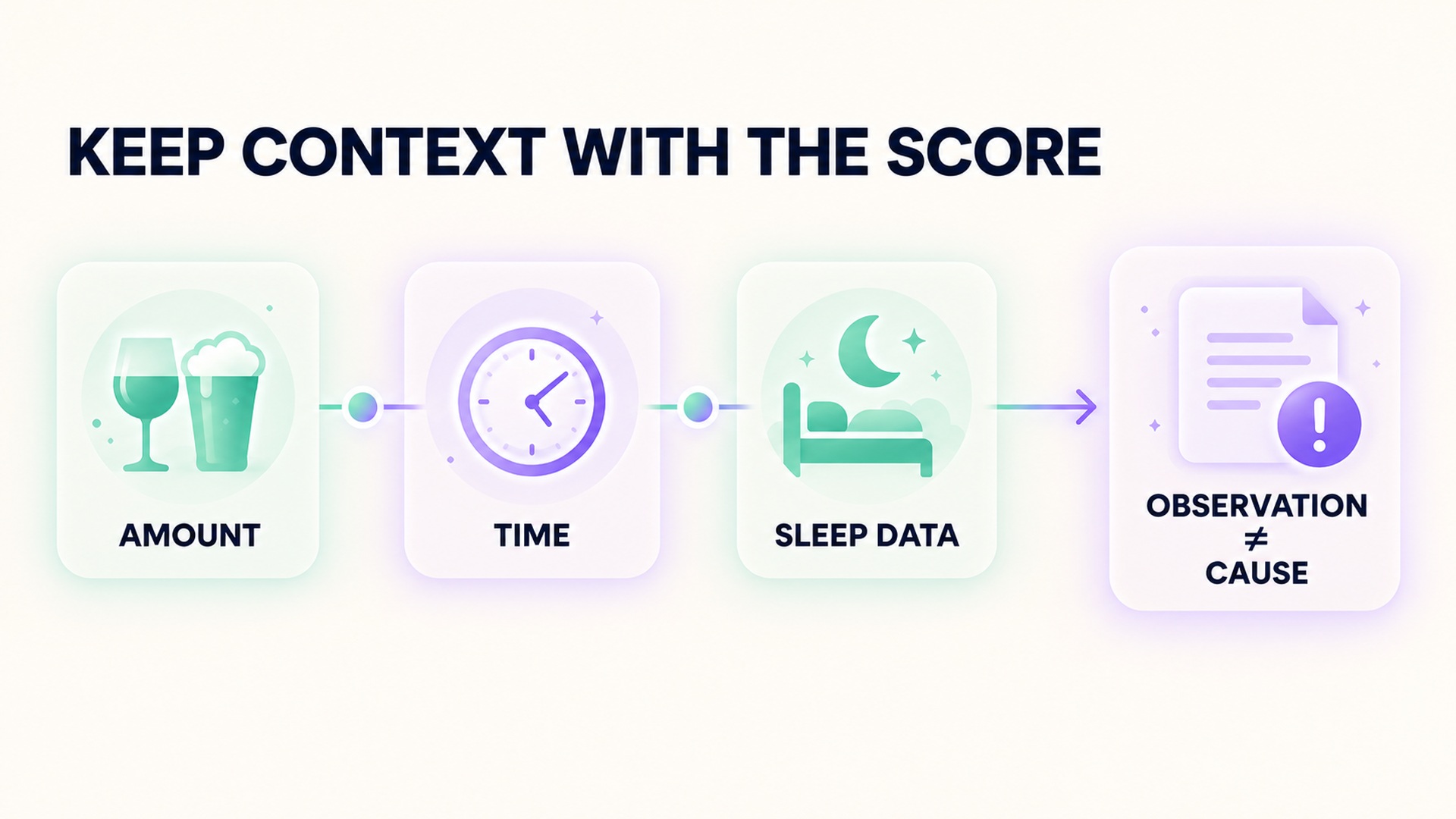
The time field is also useful. If the question is about sleep, an entry before bed is not the same as an entry much earlier in the day. But timing alone does not isolate an effect. A late meal, a changed bedtime, stress, illness, travel, or a different exercise load may occur on the same date. I would keep those context notes separate instead of assuming that one exposure explains every later metric.
Separate the record from the wearable result
Sleep duration, resting heart rate, sleep-stage estimates, and recovery scores are not interchangeable outcomes. A consumer device may estimate some of these from motion and physiological signals, and methods differ across devices. A low score after drinking does not quantify alcohol content, diagnose a condition, or prove why sleep felt different. Likewise, a normal-looking score does not establish that drinking had no effect.
A stronger personal review compares repeated observations while acknowledging the limits. Keep the same definitions for beverage amount, timing, and wearable fields. Note nights when data are missing or the device was not worn as expected. Avoid comparing one unusual night with a single “usual” night and drawing a firm conclusion. If a pattern persists, the journal can help organize questions, but it cannot replace a medical review.
Alcohol can affect judgment and coordination, and individual sensitivity varies. Public health guidance also emphasizes that the less alcohol a person drinks, the lower the risk of some harms; a public health overview of alcohol use summarizes this broader context. A health overview of drinking patterns describes why a drink count is not a personalized impairment test. Do not use a journal or wearable score to decide whether it is safe to drive, operate equipment, or undertake an activity where impairment could cause harm.
Make the journal practical and nonjudgmental
The point of a log is to preserve information, not to reward or punish a person. Use neutral terms, allow unknown values, and avoid a color-coded grade that turns the entry into a diagnosis. A person may want a record for self-reflection, to discuss a concern, or simply to compare routine changes. The journal should not imply that a certain amount guarantees a good night or that a particular score gives clearance to continue drinking.
It may help to keep beverage facts and subjective observations in separate fields. One field can capture estimated alcohol amount. Another can note whether sleep felt interrupted, whether the person felt rested, or whether the device failed to record. This makes it harder to mistake an impression for a measured value. It also keeps the data useful if someone later reviews the record with a clinician.
I would also record changes in the method. If the person starts measuring pours, uses a different serving-size reference, or changes how cocktails are estimated, mark the date. Otherwise, a new logging method can look like a change in consumption when it is only a change in measurement. The same applies to switching devices or changing which sleep metric is displayed.
If the purpose is to reduce risk or discuss drinking, a journal can support a conversation, but it should not become a home treatment plan. People who have been drinking heavily or for a prolonged period can experience withdrawal when they stop, and withdrawal can be dangerous. A clinical overview of alcohol-related care explains why medical support may be appropriate. A wearable score should never be used to decide whether someone can safely stop without professional advice.
What a count can and cannot answer
A better drink record can answer narrow questions: Was the entry based on a measured amount or a rough estimate? Did the same beverage and serving recur? Was the timing similar across the nights being compared? Did the wearable provide data on each night? These checks improve the quality of a comparison, but they do not determine cause.
A count cannot tell someone whether they have an alcohol-related disorder, whether their body has adapted to alcohol, or whether their recovery is medically complete. “Recovery” can refer to a personal goal, a sleep trend, physical recovery from training, or recovery from alcohol use disorder. Those are different ideas. If a person is receiving care, their clinician should define what information is relevant and how it should be interpreted.
The safest summary is modest: recording amount and strength is more informative than counting glasses, while every estimate has limits. Keep the original inputs and uncertainty in the journal. Treat wearable changes as observations rather than verdicts. If the record raises a concern, use it to ask for appropriate support rather than to make a diagnosis from a chart.
A related guide to interpreting wearable journals explains why timing and repeated observations matter when looking for patterns. It reinforces the same principle: a carefully kept log can make a question clearer, but it does not turn association into proof.
FAQ
What should I record besides the number of drinks?
Record the beverage amount, alcohol percentage when known, time, and whether the amount was measured or estimated. Include context that affects the comparison, such as missing device data or a changed bedtime, without assuming that any one factor caused the result.
Does a standard-drink count predict how impaired I am?
No. It is a comparison unit for alcohol amount, not a blood alcohol test or an impairment forecast. Individual response and circumstances vary, so a journal or wearable cannot establish that a person is safe to drive or perform a hazardous task.
Can a wearable show that alcohol did not affect recovery?
No. A score is an estimate based on the device’s signals and method. A normal score cannot prove that alcohol had no effect, and a lower score cannot identify alcohol as the cause. Persistent concerns are better discussed with a qualified health professional.
*This article is for informational purposes only and is not a substitute for professional medical advice, diagnosis or treatment.*
Sources:
National Institute on Alcohol Abuse and Alcoholism·National Institute on Alcohol Abuse and Alcoholism·National Institute on Alcohol Abuse and Alcoholism·National Institute on Alcohol Abuse and Alcoholism·National Institute on Alcohol Abuse and Alcoholism·Centers for Disease Control and Prevention
Related articles
Recording beyond phone range requires sensor memory support
Live sensor broadcasting and local workout storage are different capabilities. Learn what to verify before leaving a phone behind and how to confirm that the saved session transferred afterward.
Repeated vibration can add steps without walking
Wrist step counters infer walking from motion patterns, so repeated vibration can sometimes add step-like movement to a total. Learn how to identify a suspicious time block without inventing a walk or discarding the rest of the day's data.

Instant pace can fluctuate while lap pace stays stable
Current pace and lap pace summarize different time windows, so one can jump while the other stays steady. Learn which field fits a live pacing decision and which is better for reviewing a sustained segment.

When a recorded route cuts corners, distance can be understated
A GPS route can connect recorded positions with a line that clips tight bends, leaving out part of the path. Learn why sampling, signal conditions, and route rendering can affect distance without implying a change in fitness or pace.
Why a floor counter can change when air pressure changes
Some wearable floor counters estimate elevation from air pressure and movement signals. Learn why weather, doorways, and calibration can affect the estimate, and how to review a surprising count.
Dry chest strap electrodes can distort the start of a workout
Some chest straps need specific electrode preparation to make reliable skin contact. Learn how dry or moving contact can affect an early trace and what to check before treating a startup spike as a heart-rate change.
Cold skin can weaken a wearable pulse signal
Cold exposure can reduce blood flow near the skin and make an optical wrist signal harder to read. Learn how to check a device-specific trace without mistaking missing data for a cardiovascular finding.
Tattoos can affect optical heart rate readings differently from skin tone
Tattoo ink and natural skin pigmentation are distinct factors for optical heart-rate sensors. Learn how to check a device-specific trace without generalizing from one wearable study or treating a gap as a health finding.
Check live sensor support separately from workout import support
A heart-rate graph arriving after a workout does not show whether an external sensor streamed data live. Check sensor pairing, app compatibility, active recording, and later import as separate steps.
A heart rate export may not contain beat interval data
A heart-rate export can contain many beats-per-minute samples without preserving the interval between each beat. Learn which fields to check before treating a file as suitable for HRV analysis.