Sleep changes after reducing alcohol need more than a score comparison
By Mr.Apps · Oct 22, 2026
Category:Wearable
When someone reduces alcohol, a sleep score may move up, down, or stay about the same. None of those outcomes explains the whole change. Sleep is affected by the amount and timing of alcohol, the person’s usual pattern, health, other substances and medicines, stress, and the measurement method. If drinking has been heavy or prolonged, withdrawal can add urgent medical risks. For those reasons, I would treat a score as one observation in a broader record, not as proof that reducing alcohol has or has not helped.
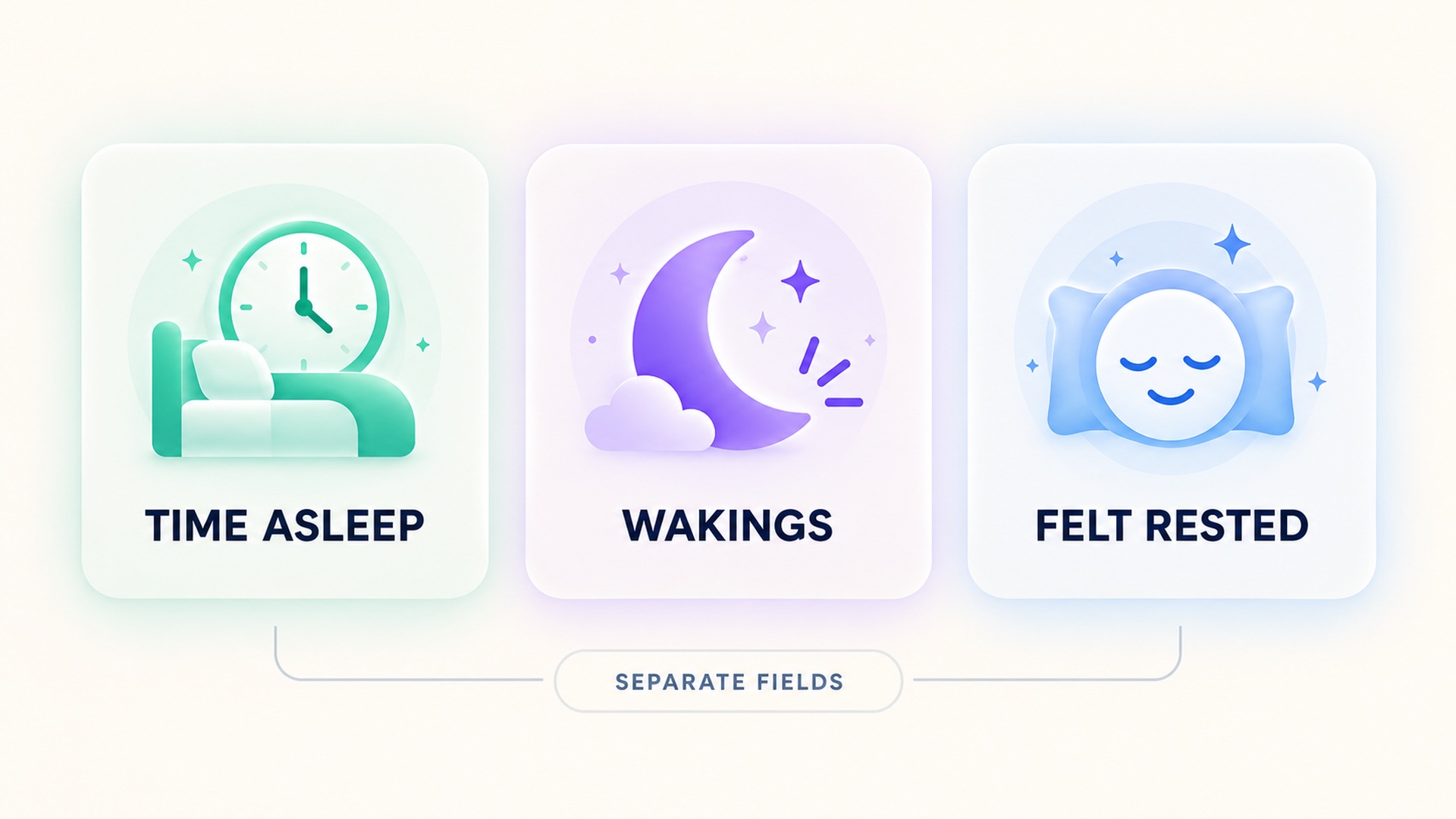
The first question is what “sleep change” means. It could refer to how long someone slept, how often they woke, how rested they felt, a device’s estimate of sleep stages, or an overall score. These are different measures. A careful record keeps them distinct and notes when the device did not capture the night well.
Expect more than one possible pattern
Alcohol can make a person feel sleepy sooner while disrupting sleep later in the night. A health explanation of hangovers and sleep notes that sleep may be fragmented and that people may wake earlier after drinking. But a change after reducing alcohol is not guaranteed to appear immediately as a higher score. Timing and amount differ, and a wearable may summarize only part of the sleep experience.
Research on sleep and alcohol also does not imply that every person will show the same pattern. A systematic review of alcohol’s effects on subsequent sleep found evidence about some sleep-architecture changes while noting uncertainty for other outcomes. A consumer score is not equivalent to the measurements in a sleep study, and a personal diary cannot establish a clinical effect from one or two nights.
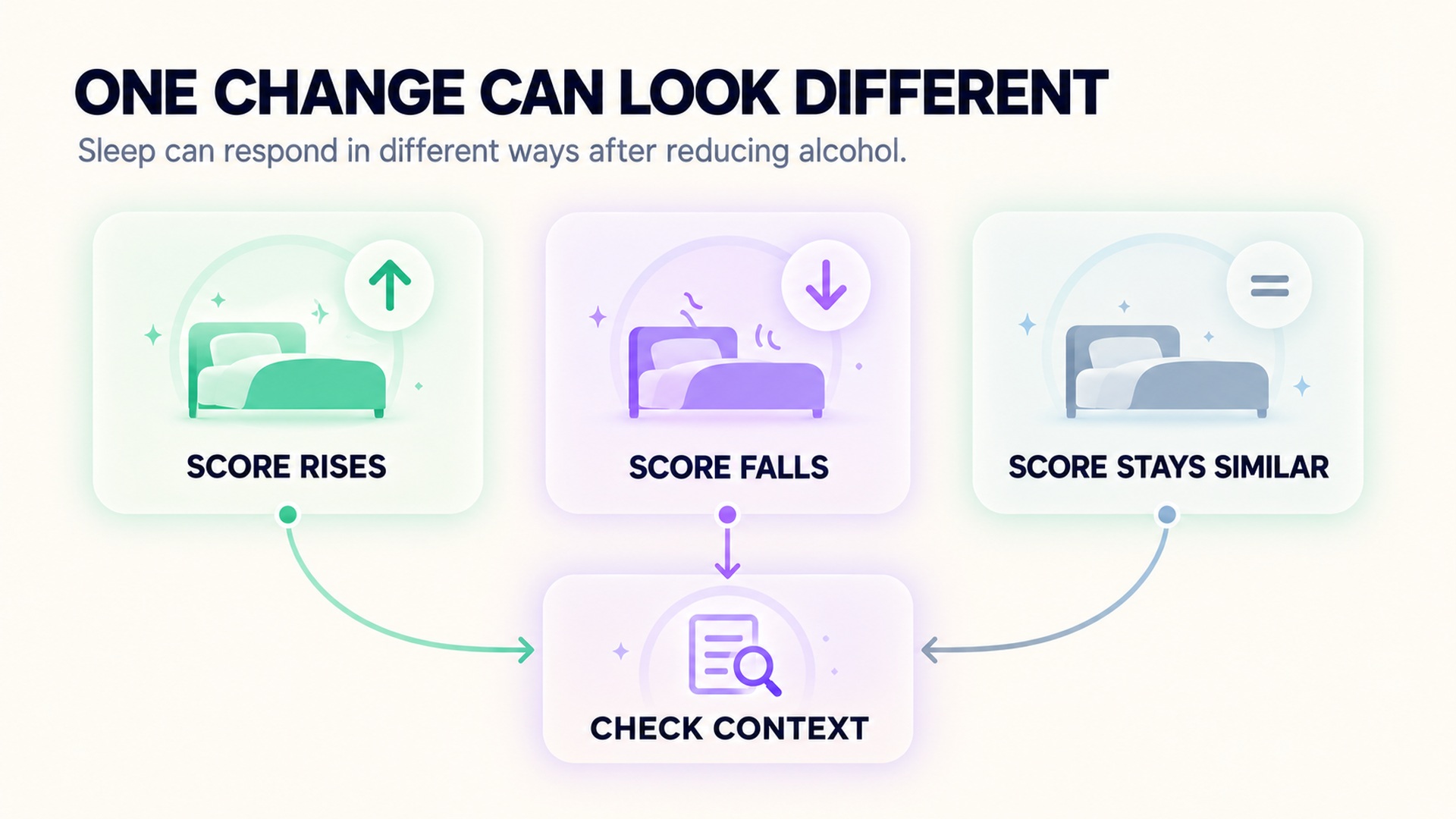
If someone has used alcohol regularly to fall asleep, reducing it may coincide with a period when sleep feels unsettled. That experience deserves attention, but it should not be interpreted from a graph alone. Mood, stress, bedtime, medication, illness, and changes in routine can influence the same nights. A review of sleep disturbances during alcohol recovery discusses how sleep and alcohol use can affect one another; it does not provide a timetable that can predict an individual’s recovery.
A “better” score also needs definition. A device may score duration, timing, movement, heart rate, or its own modeled recovery estimate. It may not reveal why the value changed. If the model or device changes during the review period, the two numbers may not be comparable. Keep the displayed field and device context with each observation.
Safety comes before tracking
Sleep disruption can occur alongside alcohol withdrawal, and withdrawal can be dangerous for some people. If a person has been drinking heavily or for a prolonged period, they should not use a wearable, sleep diary, or online schedule to plan an abrupt stop. A clinical overview of alcohol-related care explains that withdrawal may require medical assessment and monitoring.
A guide to considering a change in drinking advises people to seek medical help to plan a safe recovery when withdrawal is a concern. Symptoms can include nausea, rapid heart rate, or seizures. Severe or rapidly worsening symptoms need urgent medical attention. Do not wait for a score to confirm that help is needed.
A sleep score is particularly limited in this situation because it does not assess withdrawal risk. A normal overnight heart-rate estimate cannot rule out a serious problem, and a poor night cannot show whether symptoms are withdrawal, ordinary insomnia, or another health issue. The clinical context matters more than the consumer metric. A treatment guide for alcohol problems describes professional treatment settings and support options; it is a better starting point than attempting to infer safety from a dashboard.
Keep observations useful and neutral
For a sleep review, define a small set of fields and use them consistently: bedtime and wake time, approximate sleep opportunity, awakenings or symptoms the person noticed, alcohol timing and amount if known, other relevant changes, and whether the device was worn and recorded. Include the subjective report—such as “felt rested” or “woke several times”—separately from the device estimate.
Do not make the log more exact than the measurements. If the amount consumed was estimated, label it as estimated. If the device missed part of the night, mark the gap. If the person changed the device, its settings, or the way they log sleep, note when that happened. Otherwise, a change in recording can look like a change in health.
A comparison is more useful when the conditions are reasonably similar across several observations. Even then, it can suggest a question, not answer every causal question. Other changes often occur at the same time as alcohol reduction, including a different bedtime, meal schedule, exercise load, stress level, or use of a medication. A single variable in a diary rarely captures all of those influences.
Choose the outcome before opening the dashboard. If the concern is whether sleep feels more restorative, write down the person’s own morning assessment in the same simple way each day. If the concern is waking during the night, track that separately from total time asleep. If the question is about a device estimate, preserve the exact field name and any recording-quality note. Combining several measures into one homemade “recovery” rating can hide which part changed and encourage overinterpretation.
It is also reasonable to leave some days out of a comparison when the information is not comparable. A night with a missing recording is not a zero. A late shift, acute illness, travel, or a device charge gap can change the conditions enough that the number should be labeled separately. Excluding a night from one analysis does not mean deleting it from the person’s history; it means acknowledging that the available data answer a different question. This careful separation helps make a discussion more accurate.
A person can also feel worse before feeling better, or notice no clear difference. Neither outcome means the effort has failed. The direction of change may depend on the starting pattern, the length of observation, and other conditions that are not visible in the app. Avoid setting a deadline by which a score “should” improve; that can turn tracking into pressure and make ordinary variation seem like failure. Some people have an existing sleep condition that needs separate care. Persistent insomnia, breathing concerns, severe daytime sleepiness, or worsening mental or physical symptoms should be discussed with a qualified clinician rather than attributed to a wearable trend.
Separate sleep recovery from alcohol recovery
The term “recovery” can refer to sleep, exercise, or recovery from alcohol use disorder. A training app may combine several signals into a readiness estimate, but it is not evaluating remission, withdrawal, or treatment progress. A favorable training score should not be interpreted as proof that alcohol-related health is unaffected. A low score should not be treated as a diagnosis either. If the score changes but the person feels the same, record both facts instead of forcing them to agree. If the person feels worse while the score is stable, that difference is also useful context to share. The point is not to pick a winner between subjective experience and an algorithm; it is to understand what each source can observe and when an experienced professional should interpret the concern.
Sleep itself has several dimensions. Total time in bed differs from estimated time asleep. Feeling refreshed differs from a device’s stage labels. The wake-ups someone remembers may not match movement-based classifications. These differences do not make one measure worthless; they mean the measures need clear names and boundaries.
A clinician may be able to interpret a symptom history, medications, drinking pattern, and sleep concerns together. The person can bring the journal as a concise record, not as a substitute for an assessment. A related guide to interpreting wearable journals explains how to keep a timing pattern separate from a causal conclusion.
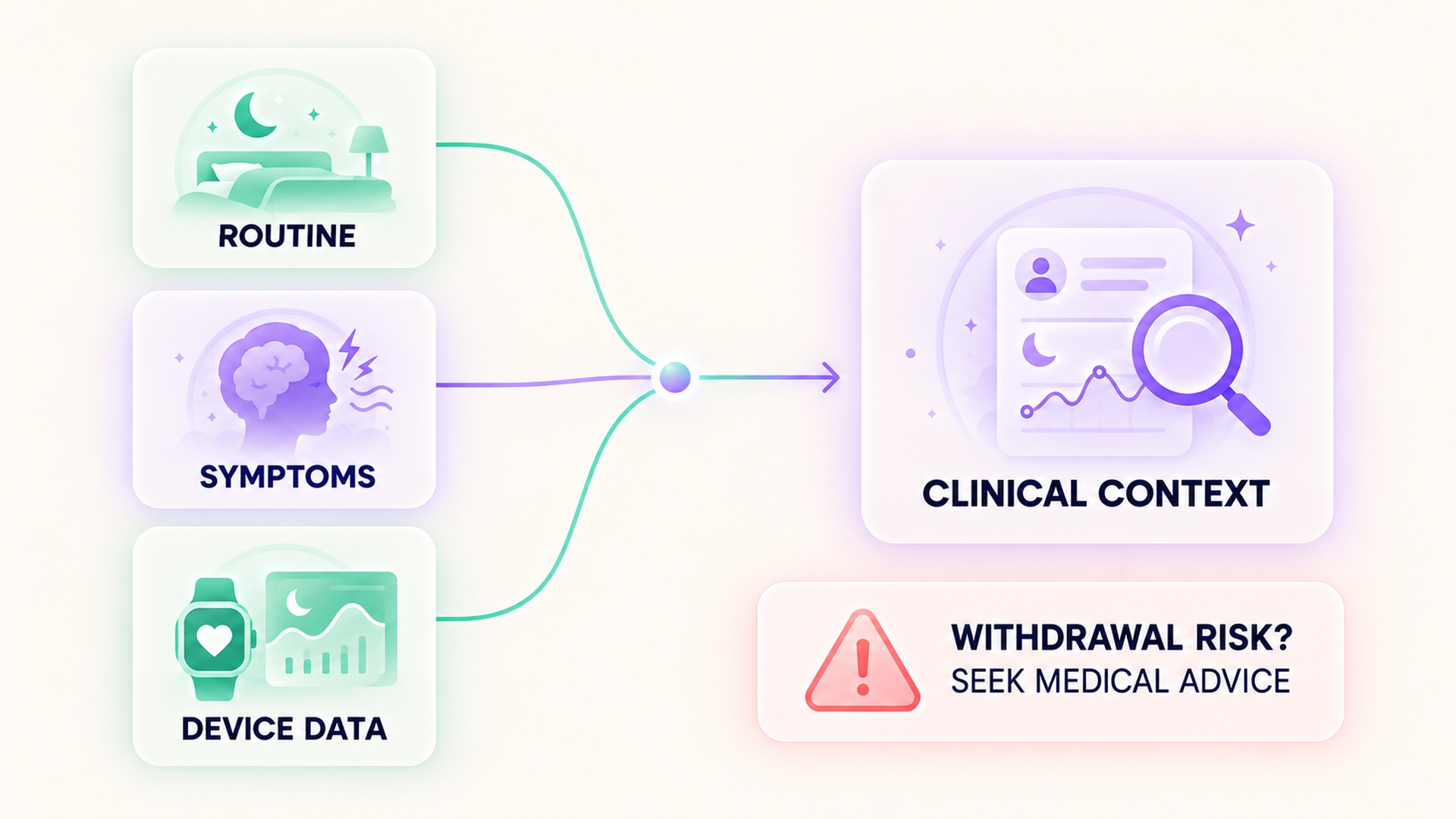
The most reliable summary is specific and modest: what changed, when it changed, what the person noticed, and what the device estimated. That gives a clinician or the person a clearer account without claiming that a score proves recovery. If withdrawal could be involved, obtain medical guidance before changing drinking patterns; do not let the tracking plan delay support.
A clear log can support a focused conversation, but it should not create a deadline for improvement or substitute for care when symptoms continue.
FAQ
Can sleep get worse after reducing alcohol?
It can. Sleep changes may reflect withdrawal, other routine changes, an underlying sleep problem, or measurement variation. Heavy or prolonged drinking can make withdrawal medically serious, so seek professional guidance before stopping abruptly if that risk may apply.
Does a higher sleep score prove that reducing alcohol improved sleep?
No. It shows that the device’s estimate changed. Review the underlying fields, the person’s own experience, recording gaps, and other changes before drawing any conclusion. A score is not a clinical assessment.
Should I wait for wearable data before seeking help for withdrawal symptoms?
No. A wearable cannot assess withdrawal risk. Seek medical advice if stopping or reducing alcohol may cause withdrawal, and get urgent care for severe or rapidly worsening symptoms.
*This article is for informational purposes only and is not a substitute for professional medical advice, diagnosis or treatment.*
Sources:
National Institute on Alcohol Abuse and Alcoholism·Sleep Medicine Reviews·Neuropsychopharmacology·National Institute on Alcohol Abuse and Alcoholism·National Institute on Alcohol Abuse and Alcoholism·National Institute on Alcohol Abuse and Alcoholism
Related articles
Alcohol tolerance does not establish that recovery is unaffected
Feeling less affected by alcohol does not show that the body or sleep is unaffected. Keep subjective tolerance, drinking records, wearable estimates, and clinical recovery as separate questions.
Count alcohol content rather than glasses in a recovery journal
A glass count can hide differences in serving size and alcohol strength. Record the beverage amount and its alcohol content so a journal preserves the inputs behind each estimate.
Recording beyond phone range requires sensor memory support
Live sensor broadcasting and local workout storage are different capabilities. Learn what to verify before leaving a phone behind and how to confirm that the saved session transferred afterward.
Repeated vibration can add steps without walking
Wrist step counters infer walking from motion patterns, so repeated vibration can sometimes add step-like movement to a total. Learn how to identify a suspicious time block without inventing a walk or discarding the rest of the day's data.

Instant pace can fluctuate while lap pace stays stable
Current pace and lap pace summarize different time windows, so one can jump while the other stays steady. Learn which field fits a live pacing decision and which is better for reviewing a sustained segment.

When a recorded route cuts corners, distance can be understated
A GPS route can connect recorded positions with a line that clips tight bends, leaving out part of the path. Learn why sampling, signal conditions, and route rendering can affect distance without implying a change in fitness or pace.
Why a floor counter can change when air pressure changes
Some wearable floor counters estimate elevation from air pressure and movement signals. Learn why weather, doorways, and calibration can affect the estimate, and how to review a surprising count.
Dry chest strap electrodes can distort the start of a workout
Some chest straps need specific electrode preparation to make reliable skin contact. Learn how dry or moving contact can affect an early trace and what to check before treating a startup spike as a heart-rate change.
Cold skin can weaken a wearable pulse signal
Cold exposure can reduce blood flow near the skin and make an optical wrist signal harder to read. Learn how to check a device-specific trace without mistaking missing data for a cardiovascular finding.
Tattoos can affect optical heart rate readings differently from skin tone
Tattoo ink and natural skin pigmentation are distinct factors for optical heart-rate sensors. Learn how to check a device-specific trace without generalizing from one wearable study or treating a gap as a health finding.