Sodium and salt amounts should not be entered as the same number
By Mr.Apps · Oct 22, 2026
Category:Wearable
Sodium and salt are often used as if they were the same thing, but a nutrition label and a food description may refer to different quantities. Salt is sodium chloride; sodium is one component of that compound and is the nutrient value commonly listed on packaged food labels. If I copy a salt amount into a field that expects sodium, or reverse those fields, the record no longer means what it appears to mean.
When I review a food record, I keep the label unit and the food description distinct. This is a data-entry issue, not a reason to calculate a personal electrolyte prescription. A food log can preserve what a label says and how much was eaten. It cannot diagnose a health condition or determine how much sodium an individual should consume. Medical conditions, medications, activity, and clinician instructions can matter. Keep units clear and seek professional guidance for individual diet questions.
What the label is measuring
On the Nutrition Facts label, sodium is reported in milligrams per serving. The line describes the sodium present in the stated serving, not the mass of table salt that could be added to the food. A label-reading guide explains where sodium appears alongside other listed nutrients and serving information.
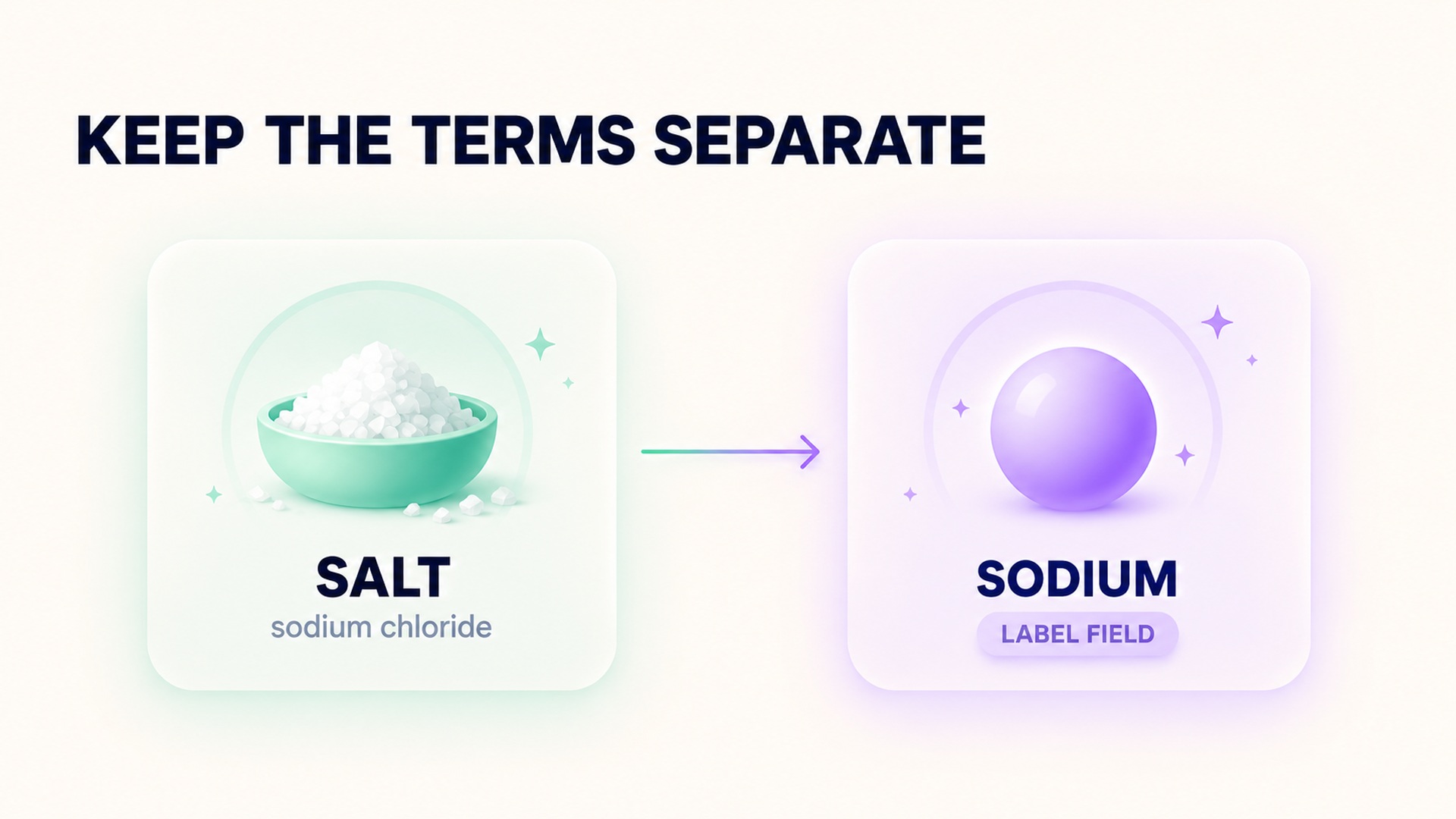
Salt contains sodium and chloride, so the two quantities are connected but not identical. Converting between them requires a defined conversion and the correct units. A log that simply renames “salt” as “sodium” without doing that conversion has changed the meaning of the value. If a package reports sodium, enter the sodium value. If a recipe or diary reports salt, retain that label or use a clearly documented conversion tool rather than silently copying the number.
The distinction matters when comparing two records. One may be a nutrient amount in milligrams; another may be a recipe ingredient amount in grams or teaspoons. The numbers cannot be compared directly just because each field contains the word “salt” or “sodium.” The public health explanation of sodium in the diet also emphasizes checking the serving size before interpreting a label value.
Keep serving size and units together
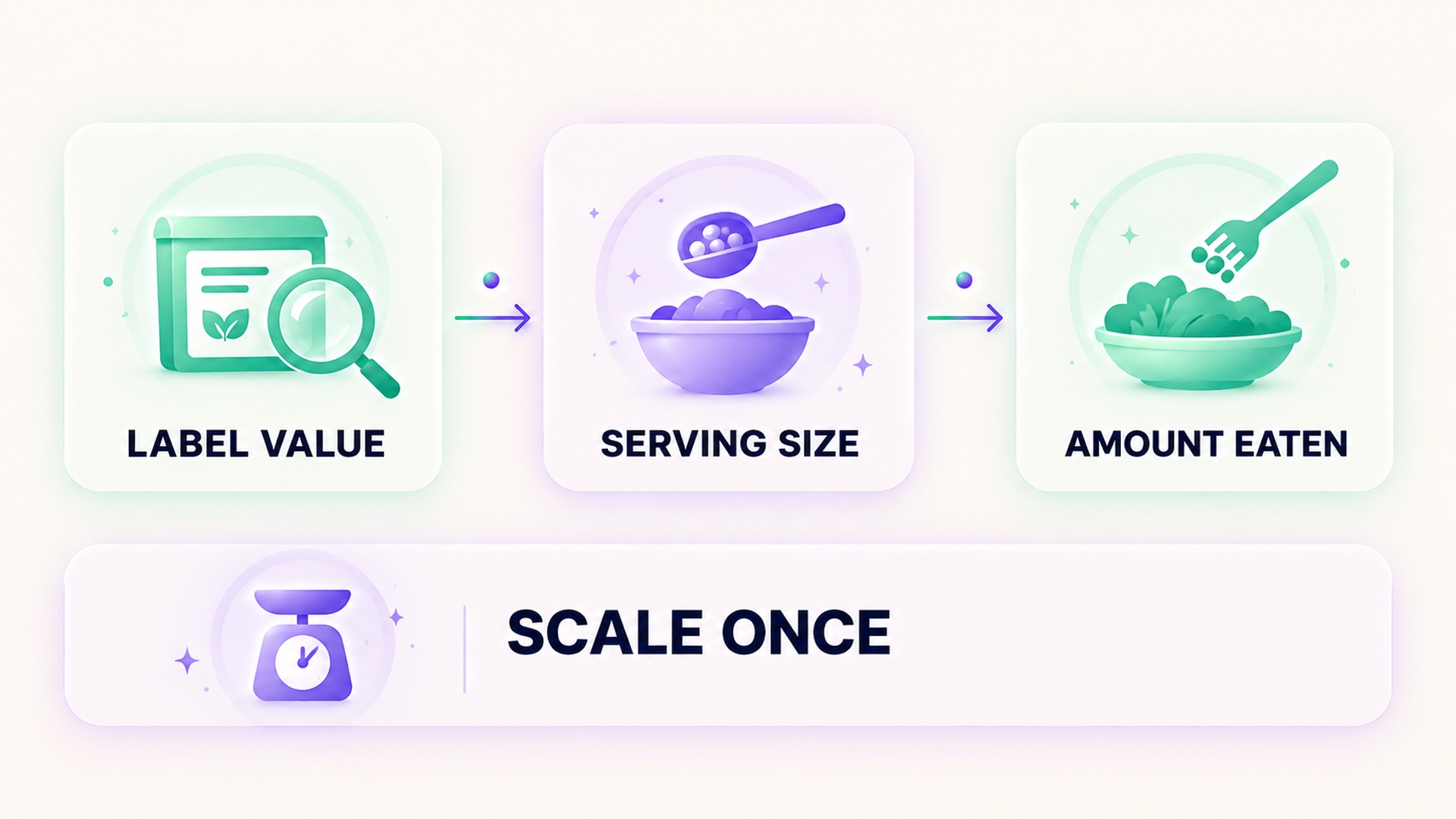
Nutrition information is usually reported for one serving, while the package may contain more than one serving. First identify the label’s serving size, then note how many servings were actually eaten. If the food log asks for sodium per serving, enter that figure with the serving. If it asks for the amount consumed, scale the value only when the portion is known.
For example, if a person eats an amount that corresponds to more than one labeled serving, the sodium total from the package should reflect the actual quantity consumed. That arithmetic should not be mixed with a conversion from salt to sodium. Keep the operations separate: first scale the label value to the portion eaten, then convert only if the destination field expects a different unit or chemical quantity.
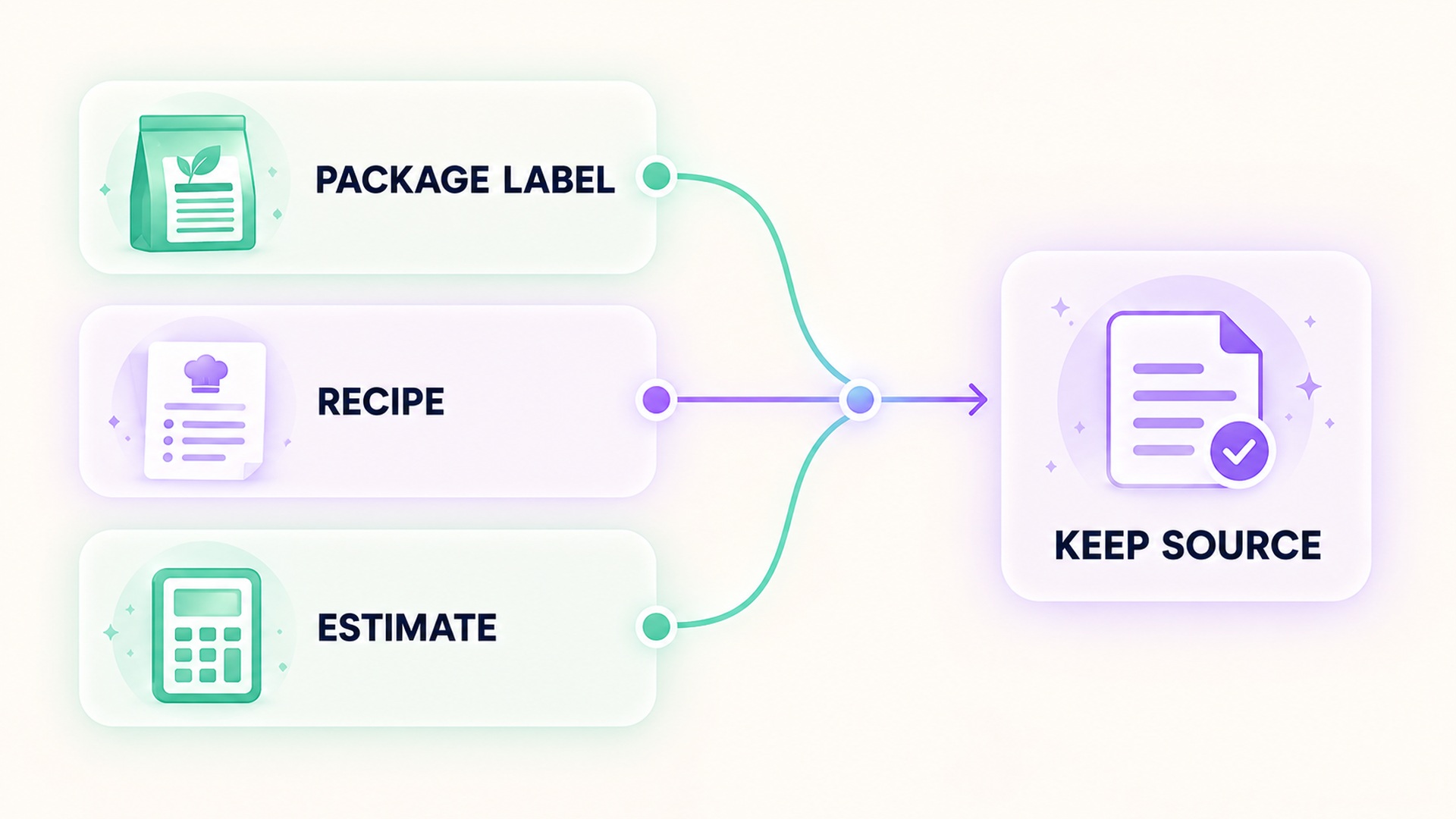
If the portion is estimated, mark it as estimated. Note whether the meal was prepared from a package, assembled from multiple ingredients, or ordered with an unknown recipe. If a recipe gives an amount of salt added to a whole dish, that does not automatically reveal how much sodium ended up in an individual portion. Ingredients, yield, and serving size must be known. A photo of a meal usually cannot provide exact sodium content because it does not show all ingredients or amounts.
A reliable record keeps the original label value, the unit, serving basis, and any conversion method. If an app stores only one number, add a note describing whether it is sodium per labeled serving, sodium for the amount eaten, or salt added in a recipe. Those are different fields. They should not be combined under a generic “salt” heading without a definition.
Avoid false precision in daily totals
A daily sum can look precise while combining inconsistent inputs. One item may be entered from a package label, another from a restaurant estimate, and another from a recipe with an unknown yield. The total should identify which entries are measured, estimated, or missing. If a source value is unavailable, mark it unknown instead of entering zero; zero means no sodium was recorded for that item, while unknown means the amount was not established.
The same issue appears when a product has multiple package sizes. Two containers with the same food name may not have identical serving size or sodium per serving. Check the package in front of you rather than relying on a remembered entry. If the label changes, record the update date and avoid retroactively applying the new label to an old food log unless the database specifically says it has revised prior entries.
Restaurant meals are harder to quantify because portion size, recipe, and preparation can vary. A database value may be a useful estimate, but it is not the same evidence as a current package label. Keep a source tag such as “restaurant estimate” or “database average” and do not imply laboratory precision. Public sodium guidance for food choices can provide general context, but it does not solve uncertainty about a particular meal or replace a clinician’s plan.
The overview of nutrition labels and serving information explains why serving size is necessary to interpret the nutrient column. A nutrition reference on sodium provides general background on sodium’s role and food sources. These references help clarify terminology; they do not set an individual target for every reader.
Do not compare numbers from different databases without checking what each number represents. One source may list sodium per 100 grams; another may use a household serving. Some databases distinguish raw and prepared food. A generic entry can be quite different from a specific product label. Keep the data source attached to the record so a later review can reproduce the calculation.
Keep interpretation separate from measurement
A high or low food-log estimate is not a laboratory test. It does not measure blood sodium or show how the body is handling fluid. A wearable’s sweat, recovery, or hydration estimate does not validate a sodium entry either. Those data sources address different questions. A consumer fact sheet on sodium offers background about sodium in food and the body, but a consumer log should not be used to change medical advice.
Some people may see daily totals fluctuate because the record is incomplete, not because the underlying diet changed. A missing restaurant estimate, a changed serving size, or a food entered under a different database item can shift the sum. Review the entries before interpreting a trend, and mark days with major gaps so the chart does not imply a complete comparison.
Some people have clinician-directed nutrition plans or conditions that make sodium management important. Others may be tracking food for a different reason. The same label arithmetic applies, but what the numbers mean for a person can differ. If there is a prescribed target, use the clinician’s definition and confirm whether it refers to sodium or salt and which units are expected. Do not infer a treatment target from a generic app field.
Before entering a converted number, check whether the app’s field is asking for sodium content, salt equivalent, or the quantity of salt added during cooking. These labels may sound similar in everyday conversation, but the software may use them in different calculations. If the unit is not documented, do not assume that a field named “salt” expects the same input as the Nutrition Facts label. Ask the app provider or a nutrition professional for clarification rather than forcing a value into the wrong field.
If a clinician’s instructions use a different unit than an app, preserve the original instruction and clarify the mapping before entering the target. Do not change a medical plan to fit a software field. That distinction protects the record.
A clean record is modest: it says what the label reported, how much was eaten, and whether the value was converted. When the source is uncertain, that uncertainty belongs in the entry. This prevents a numerical display from implying a precision the food record does not have. A related guide to keeping wearable and nutrition observations in context explains why a recorded value should not be treated as a diagnosis or causal explanation.
If label directions are unclear, save the packaging details and ask a qualified nutrition professional which field and unit the plan expects.
FAQ
Is sodium the same as salt on a food label?
No. Sodium is a nutrient component of salt, while salt usually refers to sodium chloride. A label’s sodium amount should be entered as sodium, not copied into a salt field without a documented conversion.
Should I convert the sodium value before logging it?
Only if the destination field expects a different quantity or unit, and then use a reliable conversion method. Keep the original label value, serving size, unit, and conversion method visible so the record can be reviewed.
Can a wearable or food log show whether I need more sodium?
No. These records do not diagnose a deficiency or set an individual intake target. Follow clinician guidance for personal medical or nutrition questions, especially if you have a condition or prescribed plan.
*This article is for informational purposes only and is not a substitute for professional medical advice, diagnosis or treatment.*
Sources:
U.S. Food and Drug Administration·U.S. Food and Drug Administration·U.S. Food and Drug Administration·MedlinePlus·National Heart, Lung, and Blood Institute·Centers for Disease Control and Prevention
Related articles

Add caffeine milligrams across drinks, foods and supplements
A caffeine journal is more accurate when it counts milligrams from drinks, foods, and supplements together. Keep product serving sizes and unknown amounts visible instead of treating each item as one equal dose.

Sleep changes after reducing alcohol need more than a score comparison
Sleep may change after someone reduces alcohol, but a score comparison cannot explain the cause or the course. A useful review includes symptoms, timing, routine, device limits, and medical support when needed.

Alcohol tolerance does not establish that recovery is unaffected
Feeling less affected by alcohol does not show that the body or sleep is unaffected. Keep subjective tolerance, drinking records, wearable estimates, and clinical recovery as separate questions.

Count alcohol content rather than glasses in a recovery journal
A glass count can hide differences in serving size and alcohol strength. Record the beverage amount and its alcohol content so a journal preserves the inputs behind each estimate.

Recording beyond phone range requires sensor memory support
Live sensor broadcasting and local workout storage are different capabilities. Learn what to verify before leaving a phone behind and how to confirm that the saved session transferred afterward.

Repeated vibration can add steps without walking
Wrist step counters infer walking from motion patterns, so repeated vibration can sometimes add step-like movement to a total. Learn how to identify a suspicious time block without inventing a walk or discarding the rest of the day's data.

Instant pace can fluctuate while lap pace stays stable
Current pace and lap pace summarize different time windows, so one can jump while the other stays steady. Learn which field fits a live pacing decision and which is better for reviewing a sustained segment.

When a recorded route cuts corners, distance can be understated
A GPS route can connect recorded positions with a line that clips tight bends, leaving out part of the path. Learn why sampling, signal conditions, and route rendering can affect distance without implying a change in fitness or pace.

Why a floor counter can change when air pressure changes
Some wearable floor counters estimate elevation from air pressure and movement signals. Learn why weather, doorways, and calibration can affect the estimate, and how to review a surprising count.

Dry chest strap electrodes can distort the start of a workout
Some chest straps need specific electrode preparation to make reliable skin contact. Learn how dry or moving contact can affect an early trace and what to check before treating a startup spike as a heart-rate change.